
Wednesday, 15 October 2014
Ode to the Ordinary
In Class students have been working on creating some fantastic poetry inspired by the Chilean poet Pablo Neruda.
Here is an example of his writing:
Ode to a Large Tuna in the Market
by Pablo Neruda
Here,
among the market vegetables,
this torpedo
from the ocean
depths,
a missile
that swam,
now
lying in front of me
dead.
Surrounded
by the earth's green froth
—these lettuces,
bunches of carrots—
only you
lived through
the sea's truth, survived
the unknown, the
unfathomable
darkness, the depths
of the sea,
the great
abyss,
le grand abîme,
only you:
varnished
black-pitched
witness
to that deepest night.
Only you:
dark bullet
barreled
from the depths,
carrying
only
your
one wound,
but resurgent,
always renewed,
locked into the current,
fins fletched
like wings
in the torrent,
in the coursing
of
the
underwater
dark,
like a grieving arrow,
sea-javelin, a nerveless
oiled harpoon.
Dead
in front of me,
catafalqued king
of my own ocean;
once
sappy as a sprung fir
in the green turmoil,
once seed
to sea-quake,
tidal wave, now
simply
dead remains;
in the whole market
yours
was the only shape left
with purpose or direction
in this
jumbled ruin
of nature;
you are
a solitary man of war
among these frail vegetables,
your flanks and prow
black
and slippery
as if you were still
a well-oiled ship of the wind,
the only
true
machine
of the sea: unflawed,
undefiled,
navigating now
the waters of death.

Sunday, 8 December 2013
monday 9th
We have been exploring PISA rankings as part of our statistical inquiry. PISA is an exam that tests students and is used by governments to rank how effectively their education systems are. It is a comparative exam, in that the governments can compare their results with other countries in the OECD.
OECD
Today for pānui, we will explore two articles. The first being
http://www.bbc.co.uk/news/education-25187993
Watch the video and describe the average day for a student in Korea.
Remember to write proper responses to these questions, not just one word answers. Try and incorporate the question with the answer.
Group activity
Sketch out your plan for a future school.
The Organisation for Economic Co-Operation and Development is one of the most important think tanks in the world. It collects and analyses data from 34 core countries (plus occasionally others) and uses its findings to make recommendations about government policy.
Today for pānui, we will explore two articles. The first being
http://www.bbc.co.uk/news/education-25187993
Watch the video and describe the average day for a student in Korea.
- What are some of the reasons given in the article why Korean students have to work so hard?
- What are some of the benefits of a generation of Korean students who are so good in test situations?
- What does the article say are the negatives?
Remember to write proper responses to these questions, not just one word answers. Try and incorporate the question with the answer.
Group activity
Sketch out your plan for a future school.
Monday, 11 November 2013
Maths W5
Maths Tuesday
http://www.begent.org/intelquiz.htm
Check out this logic test before you start in on today's pangarau.
PERCENTAGES
https://www.khanacademy.org/math/arithmetic/decimals/percent_tutorial/v/describing-the-meaning-of-percent
Work through the problems on the Khan Academy Website,
If you need support, please come and timetable in a workshop with me!
http://www.begent.org/intelquiz.htm
Check out this logic test before you start in on today's pangarau.
PERCENTAGES
https://www.khanacademy.org/math/arithmetic/decimals/percent_tutorial/v/describing-the-meaning-of-percent
Work through the problems on the Khan Academy Website,
If you need support, please come and timetable in a workshop with me!
Sunday, 10 November 2013

News W5
Your job this week:
Construct a news story about this News story
http://www.theguardian.com/world/2013/oct/27/thailand-racism-unilever-skin-whitening-cream-citra
Read the story, identify the key information.
Consider how this story relates to Nelson Intermediate students? What connections can you make to other learning from this year? How can we make this story fit the NIS News format?
You will probably need to develop some interview questions about this story for NIS students to respond to.
Construct a news story about this News story
http://www.theguardian.com/world/2013/oct/27/thailand-racism-unilever-skin-whitening-cream-citra
Read the story, identify the key information.
Consider how this story relates to Nelson Intermediate students? What connections can you make to other learning from this year? How can we make this story fit the NIS News format?
You will probably need to develop some interview questions about this story for NIS students to respond to.
Thursday, 31 October 2013
making kites research
http://www.youtube.com/watch?v=Z2QLdTiOU3c
http://www.my-best-kite.com/how-to-make-a-diamond-kite.html
http://www.my-best-kite.com/how-to-make-a-diamond-kite.html
Wednesday, 30 October 2013
4Ps of Marketing - For help with your homework!
Homework Tonight!
Research a product and show how it is PROMOTED, PRICED and PLACED.
Try and make it as visually appealing as possible.
PĀNGARAU THURSDAY
EUKLIDS
Jordyn, Uk Hlei, Michael, Isaac, Jaslyn, Jordyn, Paloma, Josh P, Sean, Kenai, Jake,
LI Multiplying decimals
PYTHAGOREANS
Quinn, Bailey, Jen, Caleb, Troy, Khin Khin,Danita,
LI Multiplying word problems
HYPATIAS
Stephanie, Ian, Emma, Liam, Jazmin, Josh D,
LI multiplying whole numbers word problems
Monday, 28 October 2013

Thursday, 24 October 2013
Monday, 21 October 2013
Wednesday, 16 October 2013

Wednesday, 28 August 2013

Sunday, 25 August 2013
MONDAY PLAN
UK HLEI, STEPHANIE, ISAAC, JAZMIN, QUINN and the rest of the Warriors please watch the video above. Once watched, please complete the activities here.
The rest of the class, lets just reinforce this section of that fraction test where a number of you still have some gaps. Click here
WRITING
Persuasive Writing recap
At the end of the week we are going to do an eASTLe test on persuasive writing, so we might as well quickly refocus and see what a good piece of persuasive writing needs.

Should more money and time be spent on P.E. in schools?
In your writing books complete a Venn Diagram identifying the positives and negatives of the debate.
Once completed, you are ready to start your own argument about the debate. Pick a side and remember to start it off with a punchy hook, and have at least three different paragraphs about three different reasons that you think will make your article convincing. You can work collaboratively o this. I would like you to share your arguments with me online at roomsixteenipad@gmail.com, so why not open up your google drive and work on the computers for this.
READING
READING
I read through this beautiful article on thoughtcatalog.com, and I thought you guys would find it really interesting. I would love you guys to make your own versions of these posters so we can put them up in Room Sixteen.
Students will in groups create a poster
using the large roll of paper for one of the words, students to use the skill
evaluating. Students need to make a visually appealing poster, using a strong
title, visual image and bold text to make it stand out from the rest of the crowd.
INTEGRATED STUDIES
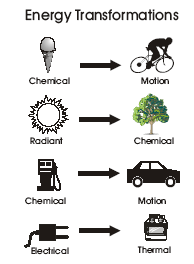
Judging from your integrated studies books, there is still some uncertainty around key vocab. So lets take it back and show our current understanding of the key vocab and show some energy changes that are occurring in our day to day lives with ordinary objects.
The chapter “Changing Energy” will be the
focus for this lesson.
Students will identify the energy changes that
are mentioned in the article and then create their own A4 poster showing how
energy is changed in an everyday object.Here are some examples:
This is an excellent example.

This is a very basic example.
Sunday, 18 August 2013
Monday, 5 August 2013
Subscribe to:
Posts (Atom)